Showing posts with label eggs. Show all posts

Friday, March 29, 2013

Naturally Dyed Easter Eggs (for Food52)

Check it out! We revisited our Naturally Dyed Easter Eggs for Food52 today.  Here’s a link to the full article.

The most exciting things? We experimented with dipping the eggs in multiple different dyes to create new colors.  We love the soft robin’s egg blue that was a result of a soak in blueberries followed by a quick dip in turmeric. And, we shot some new pictures of pretty pastel eggs to share with you!

Naturally Dyed Easter Eggs (using beet, blueberry, turmeric)

Natural Easter Egg Dye using coffee and vinegar

Natural Easter Egg Dye using turmeric and vinegar

Naturally Dyed Easter Eggs

Thursday, February 16, 2012

Baked Eggs with Crispy Hash Brown Crust

One of the highlights of our winter brunch menu was this dish:  Eggs topped with cheese, baked in a cast iron skillet, with a crispy hash brown crust hidden below.  This one is much simpler than it looks. It’s really only three ingredients: potatoes, eggs, and cheese. I love recipes that use ingredients I almost always have stocked.

Baked Eggs with Hashbrown Crust

The key to this one is pressing the freshly shredded potatoes between dish towels or layers of paper towels to get them as DRY as possible.  That dryness is what aids in their transformation to the crispy hash brown crust.  Once they’re dry you press them firmly and evenly into the bottom of a hot cast iron skillet. 

After the first side is browned you flip the whole crust over to brown on the other side.  The shredded potatoes are so intertwined that the flip is actually pretty easy to do.

Baked Eggs with Hashbrown Crust

I’ve made this multiple times over the past few weeks.  It feels special and fancy for a weekend morning breakfast, but it’s so easy to pull together. 

Baked Eggs with Hashbrown Crust


Baked Eggs with Crispy Hash Brown Crust

  • 1 1/2 – 2 cups fresh shredded potato (about 4 medium sized red potatoes)
  • 1/2 tsp salt
  • 6 eggs
  • 3/4 cup shredded cheese (we used sharp white cheddar)
  • 2 Tbsp olive oil for cast iron skillet
Shred the potatoes (I used my food processor to make quick work of this).  The quantity of potatoes you use is flexible – less will create a thinner crispier crust, more will create a thicker crust that’s soft in the middle.  I’ve done it both ways and I think I like the thinner/crispier crust… Toss the shredded potatoes with the salt, then press them firmly between two dish towels or a few layers of paper towels.  The goal is to get as much moisture out of the potatoes as possible so they’ll brown up nice and crisp.
Heat a cast iron skillet with the olive oil over medium high heat.  Add the potatoes and use the back of a large spoon to spread them evenly and then press them down firmly into a flat pancake.  Let them sit and brown, undisturbed, for about 3-4 minutes.  Make sure your heat isn’t so high that it burns the potatoes – you want them to get golden brown but not burn.  You can use your spoon to lift up an edge and take a peek to monitor progress.
When the first side is brown, use a large spatula to flip the whole thing over.  They shredded browned potatoes should be interwined with each other enough that this isn’t too difficult to do.  Let the 2nd side brown for an additional 4 minutes.
When both sides of the crust are browned, remove from heat and crack the 6 eggs evenly over the top.  Season with a little salt and pepper if desired, then sprinkle the 3/4 cup of shredded cheese over the eggs.
Pop in the oven on broil for 5-7 minutes, depending on whether you like your eggs to be soft or hard.  I like mine hard, so I let them broil for the full 7 minutes.  Slice, serve, enjoy!
Baked Eggs with Hashbrown Crust

Thursday, December 15, 2011

Baked Eggs with Prosciutto and Gruyere

Around this time of year, a lot of attention is placed on cookies and treats or elaborate holiday dinners. But don't forget about breakfast. Especially when guests are coming and going, it is nice to have a delicious, casual (but surprisingly elegant) brunch that it is just as easy to whip up for one as it is to make for ten: baked eggs with prosciutto and gruyere.
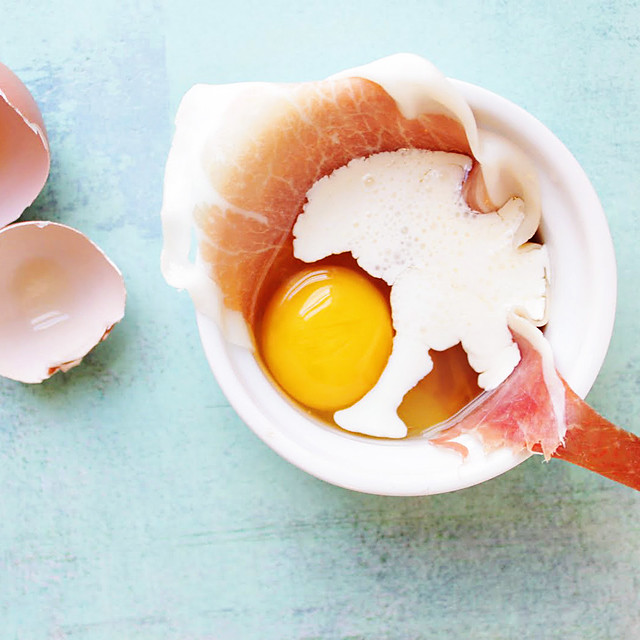
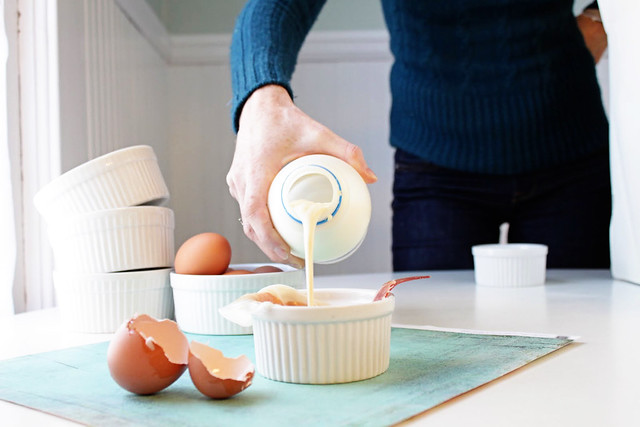
Prosciutto is draped over a ramekin, topped with an egg, drizzled with a few tablespoons of cream, and sprinkled with cheese. Bake for just 10 to 12 minutes and you have something so good, you can't believe you spent that little time preparing it.
This recipe is a spinoff of one I found in my most recent favorite cookbook: Heartland by Judith Fertig. This is a large and lavishly photographed cookbook that celebrates the food of the Midwest, where -- they say -- farm-to-table isn't a movement, it is a way of life. There are tons of tempting recipes in here, and these baked eggs were a huge hit for me.
Baked Eggs with Prosciutto and Gruyere
  • 4 to 8 slices prosciutto
  • 4 large eggs
  • 4 tablespoons cream
  • 1/4 cup grated gruyere
  • freshly ground back pepper
1. Preheat the oven to 375 F. Line 4 ramekins with prosciutto so the bottom and sides are almost completely covered. Crack an egg into each prepared ramekin. Drizzle 1 tablespoon cream on top of each egg and sprinkle each with 1 tablespoon cheese. Season with pepper.
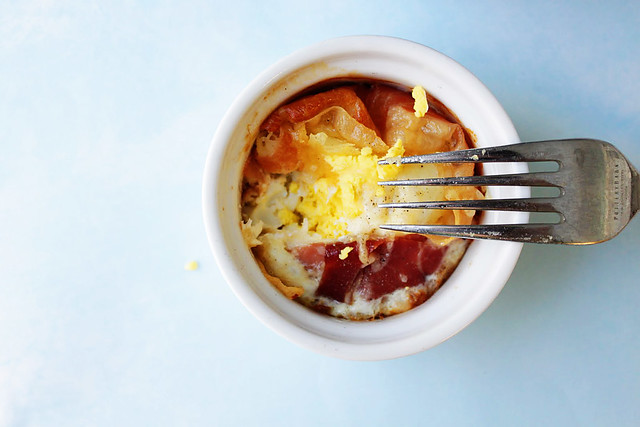
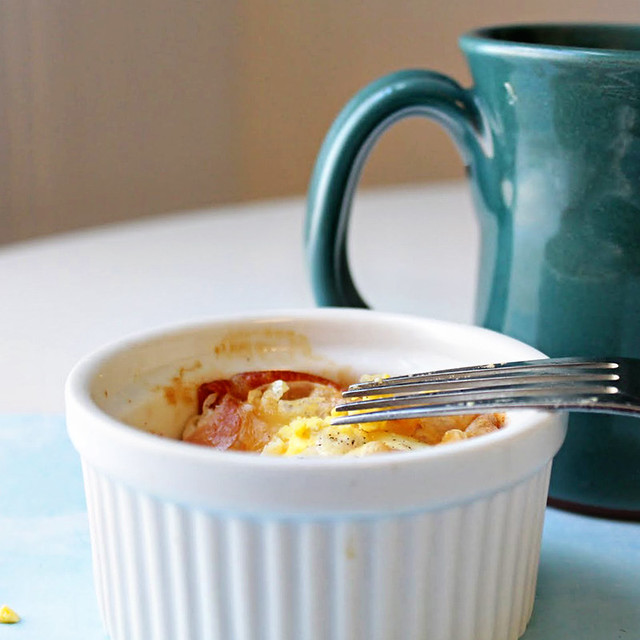
2. Place ramekins into the center of oven and bake for 10 to 12 minutes, or until the whites are set and the yolk is done to the desired firmness. (Sarah likes hers completely hard, so she let hers go a few minutes longer.) The eggs will continue to cook after you remove them from the oven, so underbake them slightly. Serve immediately. Serves 4.

Friday, April 22, 2011

Naturally Dyed Easter Eggs

Yesterday we dyed Easter eggs using only natural, whole foods: beets, blueberries, coffee, spinach, and turmeric.

The final product was actually quite beautiful!  More pastel than we’re used to, but very lovely in their own natural way:

naturally dyed easter eggs

Beets were the most successful dye, which isn’t too shocking considering they stain countertops, dishes, and clothing pretty much instantly.  They created a lovely pink shade within seconds.

natural easter eggs 005

An egg emerges from its beet bath:

easter egg dyed with beet juice

Turmeric was also very successful; it made yellow eggs.  The dark brown dye is coffee, which made tan eggs.  By the way,I felt the need to tease that you could just go buy tan eggs…  Right?

Please observe the glass lurking in the background with the sickly green dye.  That was spinach, and that was a resounding failure.  It turned the eggs a kind of dingy color - I wouldn’t even call it a green.  Or any color at all, other than maybe dirty white. 

natural easter egg dye

Here is the final product, a lovely bowl of pastel eggs & their color source.  Note that these eggs were soaked in the dye solution for just a few minutes.  Others have let the eggs soak overnight in the dye to obtain deeper colors.

eggs dyed naturally with beet, turmeric, blueberry, coffee

One note about the process: it was messy.  Consider the following steps:

  • Shredding, food processing, or blending the whole food ingredients to fully release their color.
  • Simmering the ingredient with water & a little vinegar on your stovetop for 10 minutes.
  • Straining the final dye product (to remove the pulp).
  • Then, upon an egg’s remove from its color bath it needed to be wiped off with a paper towel to remove the stray bits of vegetable pulp left on it.  If you used cheesecloth or a finer mesh sieve during the straining process, you could avoid this problem.

This would be a really fun project to do with children. Our 18 month olds were admittedly a little young to handle the process of dyeing, but they did enjoy carrying around the final product!

Henry & his spinach dyed egg

More info on how to make natural Easter egg dyes can be found here and here, however here is the general recipe.  We used beets, blueberries, spinach, turmeric, and coffee as our dye materials.

Natural Easter Egg Dye

  • 1 cup of shredded fruit or vegetable matter (beets, blueberries, etc)
  • 2 cups of water
  • 1/4 cup white vinegar
  • hard boiled white eggs

Shred, blend, process, or in someway pulverize the fruit or vegetable to be used as the dye source.  Put this material into a small saucepan and add 2 c of water.  Add the 1/4 c. of white vinegar. Simmer for 10 minutes or so, then strain through a fine mesh sieve or cheese cloth into a glass jar.  We found that bigger jars with a lot of extra room to accommodate overflow (the water lever rises a lot when you add the egg) were best. 

Let eggs sit in the dye for a few minutes or longer.  I read that you can get more intense colors by letting the eggs sit in the dye over night – if anyone has tried this, let us know.  Especially if you have comparison pictures!

Note: For turmeric, we used about 5 Tbsp in 2 cups of water.  For coffee we used straight coffee with no additional water added. Vinegar was added to both.

natural easter eggs 057

Related Posts Plugin for WordPress, Blogger...